
Apollo 11
Crewed surface exploration, samples and support systems in lunar orbit.
Apollo 11 was the first mission in which humans set foot on the Moon. The flight began on 16 July 1969, with Neil Armstrong, Buzz Aldrin and Michael Collins performing different roles. Planning landing and return within one journey makes mission design a broader engineering problem than a single landing moment.
- Launch
- 16 July 1969
- Moon landing
- 20 July 1969 / UTC
- Crew
- Armstrong · Aldrin · Collins
01 / RESEARCH LAYER
Surface and orbit belong to the same mission
Armstrong and Aldrin landed in the Sea of Tranquillity aboard the Eagle lunar module while Collins remained in lunar orbit in the command module. The surface crew’s ascent and rendezvous with the orbiting spacecraft were planned from the outset. The flight included returning the crew safely, not merely reaching the surface.
02 / RESEARCH LAYER
Scientific value of samples and experiments
Lunar rock and soil samples made laboratory investigations of the Moon’s history possible. Surface experiments and images complemented the observations. Knowing where a sample was collected and which processes may have changed it is as important as measuring its composition.
03 / RESEARCH LAYER
People, software and the ground team
Landing, guidance and communications systems worked together with astronaut decisions. Ground teams played critical roles in monitoring and planning the flight. Attributing a historical achievement to one person or one computer hides the dependencies between systems.
04 / RESEARCH LAYER
Representing history accurately
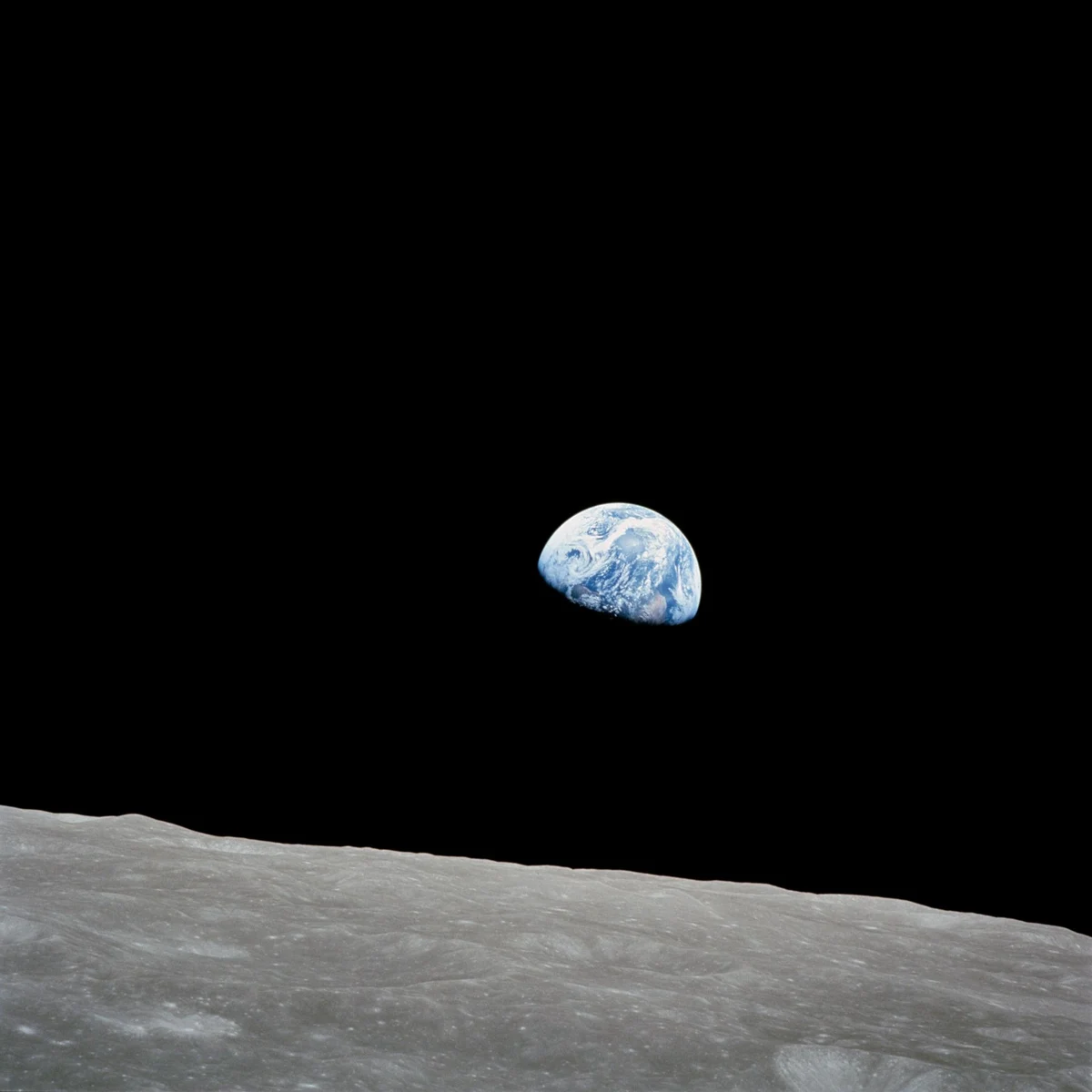
This page’s contextual image is Apollo 8’s 1968 Earthrise photograph; it is not presented as an Apollo 11 landing image. Giving mission, date and source for historical visuals is a standard of accurate science communication. Official archives preserve Apollo 11 flight records and experimental details.
05 / RESEARCH LAYER
Connecting mission stages
After exploring mass ratio and ideal velocity change in RocketLab, consider Apollo’s stages as a flow: Earth departure, lunar operations, surface ascent and return have distinct requirements. One ideal equation cannot validate the whole flight. Power, communications, life support and rendezvous timing must be considered together. Separating stages in an educational drawing illustrates this systems logic; it is not a calculation establishing historical vehicle performance or proving a mission can be carried out safely.
MISSION TIMELINE
Read the dates and the results together.
- 1969-07-16 — Launched on a Saturn V from Kennedy Space Center.
- 1969-07-19 — Lunar orbit insertion.
- 1969-07-20 — Eagle landed in the Sea of Tranquility (20:17 UTC).
- 1969-07-21 — Armstrong stepped onto the surface (02:56 UTC); 2 hours 31 minutes of surface work.
- 1969-07-24 — Columbia splashed down in the Pacific; the crew spent 21 days in quarantine.
Key results
- 21.5 kg of lunar samples: basalt ages of 3.6–3.9 billion years.
- The laser retroreflector is still used today to measure the Earth–Moon distance to millimetre precision.
- The seismometer returned the first data on the Moon’s interior.
Dates from agency mission pages; planned steps are marked “planned”. Editorial compilation: 28 October 2026. NASA · Apollo 11
IN DEPTH
Apollo 11 in depth: what 21.55 kg of rock and a panel of mirrors still tell us
Apollo 11 is usually remembered for a few hours in July 1969, yet its scientific return has kept growing for more than half a century. Samples collected in one short moonwalk are still being cut, allocated and reanalysed, and a mirror array left at Tranquility Base is still a target for laser stations on Earth. This section sets out the mission’s measured numbers, what the samples and surface experiments revealed, and where researchers can find the original data today.
The mission in numbers
The command and service module had a launch mass of 28,801 kg: 5,557 kg for the command module Columbia and 23,244 kg for the service module. Eagle touched down at 20:17:40 UT on 20 July 1969 and stayed on the surface for 21 hours 36 minutes before lifting off at 17:54:01 UT on 21 July. Columbia splashed down on 24 July after a flight of 195 hours 18 minutes 35 seconds.[1] The landing site lies in the south-western part of Mare Tranquillitatis, about 50 km from the nearest highland material and roughly 400 m west of a sharp-rimmed, blocky crater about 180 m across.[2] That geological setting matters: most of what the crew could reach was mare basalt and the soil formed on it, with highland material arriving only as small fragments.
What the samples contain
The crew returned 21.55 kg of lunar rock and soil.[1] The collection includes 50 rocks and two core tubes that reached up to 13 cm below the surface. The basalts are rich in titanium, with abundant ilmenite, and are 3.6 to 3.9 billion years old; their chemistry shows that they came from at least two distinct magma sources. Those ages mean that the lavas filling the Sea of Tranquility erupted hundreds of millions of years after the Moon formed, so the Moon remained volcanically active long after its birth. Regolith breccias, made of surface material welded together by impacts, make up much of the remainder.[3]
Two findings reached far beyond the landing site. A new mineral, armalcolite, was first identified in these samples and named from the first letters of the crew’s surnames. Small fragments of anorthosite found in the soil and breccias supported the idea that the early Moon was covered by a magma ocean, a stage now placed 4.3 to 4.5 billion years ago.[3]
The experiments left behind
Limited time on the surface meant a small package, the Early Apollo Scientific Experiments Package. Its passive seismometer, monitored from Earth by radio telemetry, operated for 21 days.[2] The first experiment the crew set up was not American: the Solar Wind Composition experiment, built at the University of Bern under principal investigator Johannes Geiss, was a 1.4 m by 0.3 m sheet of aluminium foil weighing 430 g. It faced the Sun for 77 minutes and was then brought home, giving the first measurements of the noble-gas isotopes of helium, neon and argon in the solar wind. Versions of it flew again on Apollo 12, 14, 15 and 16.[4]
The longest-lived instrument has no power supply at all. The Laser Ranging Retroreflector is a 46 cm aluminium panel holding 100 fused-silica corner cubes, each 3.8 cm in diameter, which return laser light to the direction it came from.[5]
More than half a century of laser ranging
Timing laser pulses to the Apollo reflectors and to later arrays turns the Earth–Moon distance into a precision experiment. Results summarised in a 2013 review by T. W. Murphy show that the APOLLO station in New Mexico reached a median uncertainty below 3 mm per normal point. Lunar laser ranging established that the Moon’s orbit is receding by about 3.8 cm per year, limits any change in the gravitational constant to less than one part in 1012 per year, tests the strong equivalence principle, and points to a liquid core about 350 km in radius.[6] The Apollo 11 array is smaller than the one later left by Apollo 15; by 1994, 75% of about 8,400 range measurements had been made to that larger Apollo 15 array.[7]
How the samples are curated
The six Apollo landings returned nearly 382 kg of lunar material. The main repository is the Lunar Sample Laboratory at NASA’s Johnson Space Center, built in 1979, where samples are kept in nitrogen-filled cabinets. About 52 kg, roughly 10 to 15% of the total, is stored at the White Sands Test Facility in New Mexico as a safeguard against a disaster in Houston. Around 1,900 samples are distributed each year for research and teaching, and requests are reviewed by the Curation and Analysis Planning Team for Extraterrestrial Materials (CAPTEM).[8] This controlled allocation is why Apollo 11 material can still be studied with instruments and methods that did not exist in 1969, with each new analysis planned to use as little of a finite collection as possible.
Data for researchers
Descriptions of individual Apollo 11 samples are collected on the Lunar and Planetary Institute’s Apollo 11 sample pages. Passive seismic experiment data, in SEED and ASCII formats with an expanded lunar seismic event catalogue, and the Apollo document collection are archived by the NASA PDS Geosciences Node.[9] Technical details of the reflector arrays are maintained by the International Laser Ranging Service.
Sources for this section
- NASA NSSDCA — Apollo 11 Command and Service Module (1969-059A)
- Washington University in St. Louis — Apollo 11 overview (Apollo data user guide)
- Lunar and Planetary Institute — Apollo 11 samples
- ESA — Europeans in Apollo: first flag on the Moon
- NASA ILRS — Apollo 11 lunar reflector information
- T. W. Murphy Jr. — Lunar Laser Ranging: The Millimeter Challenge (arXiv:1309.6294)
- UC San Diego, APOLLO project — Lunar retroreflectors
- National Academies — Strategic Investments in Instrumentation and Facilities for Extraterrestrial Sample Curation and Analysis (2019)
- NASA PDS Geosciences Node — Apollo missions archive
In-depth section: 29 October 2026. The sample mass is NASA NSSDCA’s figure (21.55 kg); the Lunar and Planetary Institute rounds it to 21.6 kg. Laser-ranging precision figures are from a 2013 review and may since have improved.
INTERACTIVE LAB
An orbit at the Moon’s distance: speed, period and signal delay
The “Distance of the Moon” preset sets the altitude to 378,029 km, or 384,400 km from Earth’s centre: on this circular orbit the speed is about 1.02 km/s, one orbit takes 27.5 days and the one-way signal delay to the ground is about 1.26 seconds, which is why a laser pulse fired at the reflector at Tranquility Base comes back after about 2.5 seconds. Then press the “ISS” and “Geostationary” buttons: the lower the orbit, the higher the speed and the shorter the period and the delay. Because the model ignores the Moon’s own mass, its period comes out slightly longer than the real sidereal month of 27.3 days.
CONNECTED INVESTIGATIONS
Where can you go from this dossier?
GO TO THE SOURCE
Turn reading into research.
Editorial review: . Mission status and catalogues can change; consult the official source for current information.
Image: NASA / Apollo 8 / William Anders · Earthrise, 1968; not an Apollo 11 image.