
From a wing
to a global system.
Kites, balloons and gliders offered different answers to the same questions: how to stay aloft, steer and return safely.
WORLD AVIATION HISTORY
From the idea of flight to a controllable aircraft
Kites, balloons and gliders offered different answers to the same questions: how to stay aloft, steer and return safely.
Myth, design and flight records
Aviation history cannot be reduced to one invention made by one person on one day. Stories such as that of Icarus reveal the meanings people attach to flight; technical achievement, however, requires testable evidence of what a vehicle actually did. A drawing, a working model, a glider carrying a person and a powered aircraft are separate stages. When assessing a historical claim, the date, witnesses, repeatability of the experiment and original document should be read together. This preserves cultural memory without substituting myth for measured flight.
The experimental possibilities opened by kites
Kites, which originated in China, showed that a human-made object could remain airborne. The Smithsonian dates the tradition to the fifth century BCE; this does not constitute a record proving a flight by a particular inventor on a particular day. A kite is tethered and does not belong to the same category as an aircraft carrying a person in free flight. Nevertheless, it made the relationship between wing area, balance and wind visible. Nineteenth-century experimenters used kites to test structures and control concepts.
Leonardo’s questions
Leonardo da Vinci’s importance does not lie in leaving an aircraft proven to have flown. His notes investigate birds, the movement of air and the behaviour of wings; many designs aim to generate lift and thrust by flapping wings. The Codex on the Flight of Birds, dated 1505–1506, concentrates this interest. The drawings are valuable in showing the distance between engineering imagination and successful flight. Building a design in a later period does not establish that the original machine flew during the Renaissance.
1783: People ascend by balloon
In France in 1783, hot air and hydrogen opened two different paths. Montgolfier balloons progressed from uncrewed and animal-carrying trials to human flights. Pilâtre de Rozier and the Marquis d’Arlandes flew in an untethered hot-air balloon on 21 November. Charles and Robert made a free flight in a hydrogen balloon on 1 December. The achievement here is carrying people in a lighter-than-air vehicle; it should not be confused with the birth of the powered aeroplane. Balloons made the sky accessible, but ascending and travelling in a chosen direction remained separate engineering problems.
Cayley: Separating the functions
In 1799, George Cayley set out a configuration in which separate systems could provide lift, propulsion and control in a fixed-wing vehicle. Rather than imitating every movement of a bird, this approach emphasised designing flight through analysis. His 1804 model glider tested a wing and tail working together in one structure. By 1853, a full-size glider carrying a person had been achieved. Historical accounts of these events should state the limits of the records; in particular, later additions such as conversations or precise distances should not be repeated without documentation.
From model to human-carrying glider
Flying a small model does not solve every problem of a vehicle carrying a person. Cayley’s work makes this transition in scale visible: NASA’s educational record describes the 1804 model and a larger vehicle that briefly carried a child in 1849 as separate experiments. Wing lift and flight balance can be investigated without an engine. A glider should therefore not be regarded as an incomplete aeroplane; it is an important research tool for testing aerodynamics and control concepts without adding engine weight.
Lilienthal: The power of repeated experiments
Between 1891 and 1896, Otto Lilienthal made approximately two thousand short flights with various full-size gliders. His contribution was not simply getting airborne; he turned research into sustained experimentation and built a body of experience that other designers could use. Photographs in the museum archive allow flight postures and changes in the vehicles to be traced. The exact day of the first successful trial, however, is unknown. A spectacular flight photograph alone does not show that a vehicle was stable in every condition or ready for prolonged flight.
[7] Smithsonian National Air and Space Museum · [8] Otto-Lilienthal-Museum
1903: Power, wing and control come together
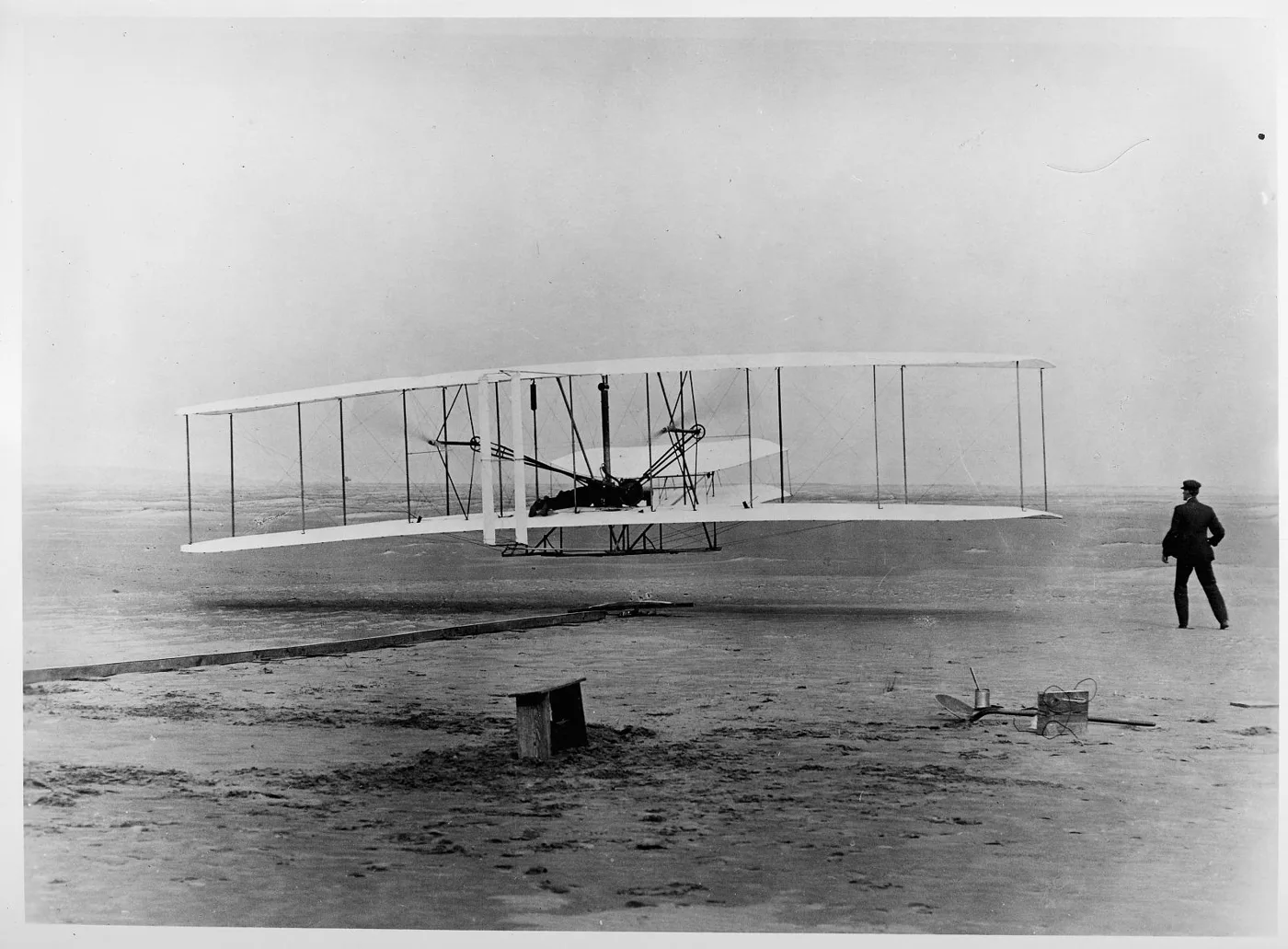
On 17 December 1903, the Wright brothers made four powered flights near Kill Devil Hills. In the first, Orville travelled 120 feet in 12 seconds; in the fourth, Wilbur flew 852 feet in 59 seconds. Their historical importance goes beyond using an engine to lift a wing: the pilot could manage the vehicle’s balance and direction. The Wrights’ three-axis control approach brought together powered, piloted, sustained and controlled flight. Photographs, diaries and witness accounts together provide a strong documentary basis for this event.
[9] Library of Congress · [10] Smithsonian National Air and Space Museum
1906: Santos-Dumont’s publicly witnessed achievement
Alberto Santos-Dumont’s flights with the 14-bis in Paris represent a different milestone. The FAI records the flight of 220 metres in 21.5 seconds on 12 November 1906 as the first officially observed flight in Europe exceeding 25 metres. Public demonstration and official observation are central here. This criterion does not invalidate the Wrights’ 1903 achievement. Rather than turning the two events into a contest for a national winner, it is more instructive to explain their distinct roles in the development of controlled flight and the official record system.
WORLD AVIATION HISTORY
From experimental craft to an air transport system
Aircraft factories, passenger cabins, rotorcraft and international rules took aviation beyond the individual flight.
Wartime production at scale
The First World War created a demand for aircraft that small workshops could not meet. In Britain, production rose from approximately 50 aircraft a month in the first year of the war to 2,700 in 1918. Furniture manufacturers experienced in working with wood and fabric also joined aircraft production; dedicated factories and government facilities expanded. This growth meant more than an increase in pilot numbers. Organising component manufacture, assembly, maintenance and personnel training also became central to aviation history.
Metal construction introduces new possibilities
In 1915, the Junkers J 1 combined metal construction and a wing that needed no external bracing wires in an experimental aircraft. Its success did not mean that every aircraft would immediately be built in the same way; a heavy structure and limited engine power affected performance. The experiment was a step towards demonstrating the practicality of metal. In 1919, the Junkers F 13 brought this accumulated experience into passenger transport. The Deutsches Museum describes it as the first metal passenger aircraft; its small cabin represented a new transport application before the arrival of larger aircraft.
[13] Technikmuseum Hugo Junkers Dessau · [14] Deutsches Museum
The economic question behind scheduled flight
Making an aircraft work and sustaining an airline were separate tasks. The St. Petersburg–Tampa route, launched on 1 January 1914, offered a short scheduled passenger connection across the water, but it did not last long. Many post-war ventures likewise failed to cover operating costs from revenue. Early commercial aviation is therefore more than a story of courageous pilots: it also involves subsidies, regular demand, maintenance and efficient aircraft utilisation. Witnessing the opening of a route is not enough to assume that a lasting transport network has been established.
The DC-3 and a viable airliner
The Douglas DC-3, which first flew in 1935, is a powerful example of air transport’s maturation. A larger cabin, reliable operation and operating economics made passenger transport more practicable for airlines. The Smithsonian’s collection record emphasises the DC-3’s role in profitable operation from passenger revenue. The historical change here is not merely increased speed. An aircraft’s ability to remain in service over successive flights, manageable maintenance needs and adequate passenger capacity are also part of success.
Reaching altitude with a pressurised cabin
The Boeing 307 Stratoliner first flew in late 1938. As the first passenger aircraft with a pressurised fuselage, it partly separated cabin conditions from the external high-altitude environment. This technology offered greater passenger comfort at altitude and the possibility of flying above some adverse weather. Pressurisation preceded the jet engine. This shows why the development of air travel cannot be attributed to a single engine revolution: the cabin, structure and flight environment were changing together.
Rotorcraft open a separate path
Juan de la Cierva’s C.4 autogiro achieved successful flights in 1923. In an autogiro, the rotor turns in airflow created by forward movement; in a helicopter, the lift-producing rotor is powered by the engine. Cierva’s work on rotor hinges was important to later helicopters. The Sikorsky VS-300 began developing through tethered tests in 1939 and contributed to the maturation of the single main rotor and torque-balancing tail rotor configuration. This history should be told without reducing every rotorcraft achievement to a single inventor or day.
[18] Smithsonian National Air and Space Museum · [19] Igor I. Sikorsky Historical Archives
1944 and 1947: Establishing a common framework
As the Second World War drew to a close, the operation of air connections in peacetime became an international question. At the conclusion of the Chicago conference, attended by representatives of 54 countries, 52 states signed a new convention on 7 December 1944. The text established shared principles and a basis for cooperation in international civil aviation. The convention entered into force and the permanent ICAO was established on 4 April 1947. Distinguishing these dates shows that a legal decision did not complete every institution and practice on the same day.
WORLD AVIATION HISTORY
From the jet age to digital and electric flight
Control, materials, reliability and certification shaped modern aviation as much as speed did.
A jet’s first flight and entry into service
The Heinkel He 178 flew under turbojet power on 27 August 1939. In Britain, the Gloster E.28/39, carrying Whittle’s engine, made its official first flight on 15 May 1941. These were experimental aircraft; flying a technology did not mean that production, reliability and service infrastructure were ready. Military use of jets such as the Me 262 began in 1944. Accounts of the jet age must keep prototype flight, series production and operational service dates separate.
[22] Virtuelles Landesmuseum Mecklenburg-Vorpommern / phanTECHNIKUM · [23] Science Museum Group · [24] National Naval Aviation Museum
Comet: The passenger jet and lessons in structure
The de Havilland Comet entered commercial jet service with BOAC on 2 May 1952. Jet engines and a pressurised cabin changed the speed and conditions of travel. Early Comet accidents, however, made fatigue resistance, particularly in pressurised fuselages, a critical research subject. The withdrawal of its airworthiness certificate in 1954 and subsequent improvements remind us that aviation history is not simply a sequence of successes. Learning from accidents and revalidating designs are also part of technological progress.
The 707 and the expanding jet network
The Boeing 707’s New York–Paris services with Pan American, beginning on 26 October 1958, mark a clear milestone in the spread of jet transport. The aircraft belonged to a family developed from the 367-80 demonstrator that flew in 1954; these two flight dates should not be used interchangeably. The 707 was not the first commercial jet. Its significance is as a symbol of wider jet use in long-haul passenger transport. New aircraft generations affected the whole transport chain, from terminals to maintenance arrangements.
Concorde: A different choice of speed
The Anglo-French Concorde prototype flew on 2 March 1969; scheduled commercial services began on 21 January 1976. Supersonic travel demonstrated how far aircraft development could push speed. The years between first flight and passenger service also reveal the importance of extensive development and testing. Concorde’s story invites consideration of why reducing flight time alone does not create a mass market. Its impact on transport history cannot be explained solely by the number of aircraft built or by a label claiming a ‘first’.
Pilot commands enter a digital system
NASA’s modified F-8 made the first flight of its digital fly-by-wire research programme on 25 May 1972. Processing pilot commands through a computer took flight control beyond the design space of mechanical linkages. The research used computer hardware from the Apollo programme. ‘Electronic’ and ‘digital’ do not mean the same thing here. Because earlier analogue applications existed, this achievement should not be presented as the sole starting point of the entire history of fly-by-wire.
A320: Fully digital controls in a passenger aircraft
The Airbus A320 first flew on 22 February 1987 and entered service in 1988. Its distinctive innovation was a fully digital fly-by-wire system in a commercial passenger aircraft. As software gained a larger role in processing commands, the pilot interface and control architecture also changed. Instead of calling the A320 ‘the first fly-by-wire passenger aircraft’, the wording should be ‘the first commercial passenger aircraft to use fully digital fly-by-wire’. This avoids obscuring the contributions of earlier analogue systems.
787: Materials are part of the system too
The Boeing 787 first flew on 15 December 2009; the first delivery to ANA was in September 2011, followed by entry into service on 26 October 2011. Extensive use of composites in its primary structure shows how material selection became central to the design. GAO’s 2011 report gives composites as approximately 50 per cent of total structural weight. This does not mean that every part of the entire aircraft is composite. First flight, delivery and commercial use are also distinct milestones.
[31] The Museum of Flight · [32] Boeing · [33] U.S. Government Accountability Office
A certified milestone in electric flight
EASA granted a type certificate to the two-seat Pipistrel Velis Electro on 10 June 2020. The agency announced this as the world’s first type certification of a fully electric aircraft. The achievement concerns a small aircraft class intended particularly for pilot training. It does not imply that large passenger jets became electric at the same time or that every flight mission acquired the same energy solution. A demonstration flight and the official certification of a particular design are clearly distinct.
Verified progress in advanced air mobility
On 22 October 2024, the FAA announced a rule covering pilot and instructor qualifications and operating provisions for powered-lift aircraft. Vehicles that can take off vertically and cruise like aeroplanes require their different flight phases to be assessed together. This regulation is a concrete step that belongs in aviation history; it does not prove that a particular manufacturer’s vehicle received a type certificate or that scheduled air taxis began operating in every city. New vehicles should be followed through completed trials and official documents rather than announced ambitions.
Continue your research.
Turkish Aviation History
From the accounts of Hezarfen and Lâgarî to the Ottoman aviation organisation, and from the Republic’s pioneers to contemporary aviation.
02 / RESEARCH DOSSIERAviation Technologies in Türkiye
Contemporary achievements in Turkish aviation: dated programme status for aircraft, uncrewed systems, avionics, engines and simulation.
03 / RESEARCH DOSSIERThe Science of Flight
Lift, drag, angle of attack and experimental methods; two interactive educational laboratories and annotated infographics.
REFERENCES / OPEN RESEARCH
Follow the evidence.
- 120 Years Ago: The First Powered Flight at Kitty Hawk ↗
- Flight Before the Airplane ↗
- Leonardo da Vinci and Flight ↗
- Expérience fait à Versailles le 19 Sept 1783 ↗
- George Cayley ↗
- Aeronautics Module ↗
- Lilienthal Glider ↗
- Photo archives Lilienthal ↗
- The Wilbur and Orville Wright Timeline: 1901 to 1910 ↗
- 1903 Wright Flyer ↗
- 12 November 1906: The first flight by Santos-Dumont ↗
- First World War: Aircraft Factories ↗
- Ju52-F13-J1 ↗
- Historic Aviation: Junkers F13 ↗
- The Early Airlines You Might Not Have Heard Of ↗
- Douglas DC-3 ↗
- Boeing 307 Stratoliner Clipper Flying Cloud ↗
- Cierva C.8W: historical account of C.4 ↗
- The Design Evolution of the VS-300 Helicopter ↗
- The History of ICAO and the Chicago Convention ↗
- The Chicago Convention: postal history archive ↗
- Model of a Heinkel He 178 ↗
- Gloster-Whittle E28/39 jet aeroplane ↗
- Me 262 ↗
- Comet Enters Service ↗
- de Havilland Comet 1XB ↗
- 707-120 First Takeoff ↗
- Concorde: The story of supersonic passenger flight ↗
- Flying with NASA – Digital-Fly-By-Wire ↗
- A320 Family: a story of continuous innovation ↗
- Boeing 787 Dreamliner ↗
- 15 years on, the 787 Dreamliner continues to lead ↗
- Aviation Safety: Status of FAA’s Actions to Oversee the Safety of Composite Airplanes ↗
- First type certification for fully electric plane world-wide ↗
- With New Rule, FAA is Ready for Air Travel of the Future ↗