
Venus
Two worlds of similar size, with very different climate histories.
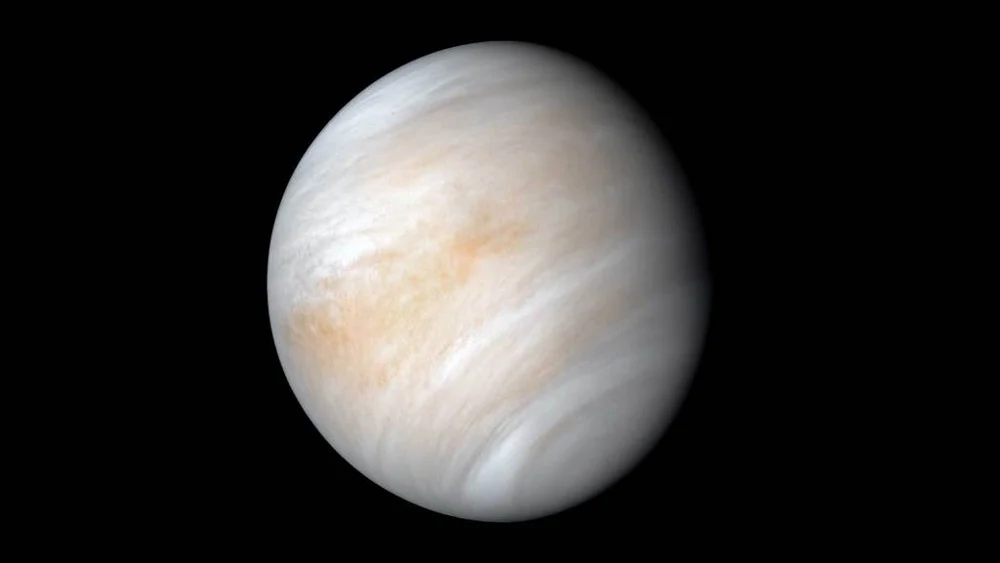
Venus is a rocky planet close to Earth in diameter, but with very different surface conditions. Beneath thick clouds lie high pressure and a strong greenhouse effect. This contrast raises a fundamental question for exoplanet research: how much does knowing a world’s size tell us about conditions at its surface?
- Class
- Rocky planet
- Mean radius
- 6.052 km
- Mean distance from the Sun
- 0,723 AU
- Orbital period
- 224.7 Earth days
01 / RESEARCH LAYER
A surface hidden beneath clouds
Venus’s rocky surface includes broad volcanic plains and mountainous regions. Thick clouds obstruct visible light, making radar mapping a fundamental tool. Interior models distinguish core, mantle and crust, but direct, detailed measurements are less extensive than those available for Earth.
02 / RESEARCH LAYER
A thick layer that retains heat
Carbon dioxide is the main atmospheric constituent; sulphuric-acid droplets occur in the upper clouds. Surface pressure is roughly 90 times Earth’s sea-level pressure, and temperatures can melt lead. Understanding a planet’s energy balance requires considering incoming sunlight, reflected light and escaping infrared energy together.
03 / RESEARCH LAYER
Slow rotation in the opposite direction
Venus rotates very slowly, in the opposite direction to most planets. One axial rotation takes approximately 243 Earth days, while its orbit of the Sun takes about 225. Rotation period and solar day are different concepts. Accelerated motion in the site’s models helps make these different timescales visible.
04 / RESEARCH LAYER
A neighbour without moons
Venus has no natural moons or rings. Its thick atmosphere and moving clouds provide a changing field of observation. Ultraviolet, infrared and radar data reveal different layers of the same object. Images of Venus that look very different need not contradict one another.
05 / RESEARCH LAYER
From surface landings to radar maps
Soviet Venera spacecraft provided direct surface data; NASA’s Magellan mission created an important radar-mapping archive. ESA’s Venus Express investigated the atmosphere. New observations and archive reanalysis keep questions about volcanism and surface change open.
06 / RESEARCH LAYER
Where did the similarity with Earth end?
How much water did Venus contain in the past? How does material continue to move between surface and atmosphere? What are the frequency and distribution of volcanic activity? These questions belong to planetary-evolution research broader than any single claim of a sign of life; a possible chemical signal requires independent verification.
READ THE NUMBERS TOGETHER
One world beside another.
Venus’s mean radius is approximately 0.95 times Earth’s; its orbital period is approximately 0.62 Earth years.
| Planet | Radius / Earth | Distance / AU | Year / Earth year |
|---|---|---|---|
| Mercury | 0,38 | 0,387 | 0,24 |
| Venus | 0,95 | 0,723 | 0,62 |
| Earth | 1,00 | 1,000 | 1,00 |
| Mars | 0,53 | 1,524 | 1,88 |
| Jupiter | 10,97 | 5,203 | 11,86 |
| Saturn | 9,14 | 9,537 | 29,46 |
| Uranus | 3,98 | 19,191 | 84,02 |
| Neptune | 3,86 | 30,069 | 164,77 |
These are rounded mean values. The AU is based on the mean Earth–Sun distance; actual distance changes along an orbit. One Earth year is taken as 365.25 days. The size ratio is not a mass or surface-gravity ratio.
NEXT DISCOVERY
Change the scale. Deepen the question.
GO TO THE SOURCE
Turn reading into research.
Editorial review: . Mission status and catalogues can change; consult the official source for current information.
Image: NASA / JPL-Caltech · Mariner 10.