
Jupiter
A vast atmosphere, a powerful magnetic environment and moons that are worlds in their own right.
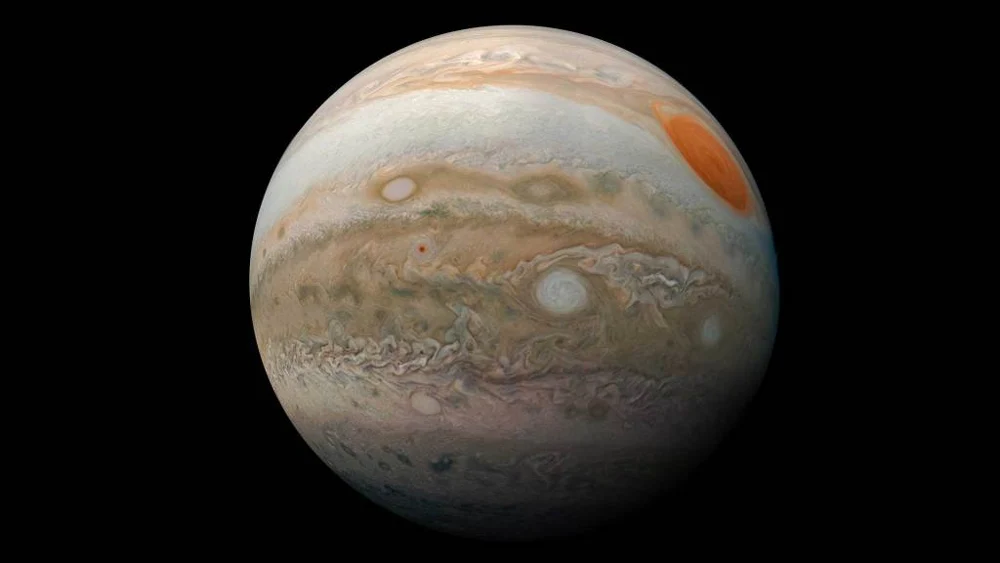
Jupiter is the Solar System’s largest planet. Its cloud bands may initially look like a surface, but it has no solid outer surface on which one could stand as on Earth. Studying the giant planet’s interior, atmosphere and moons together supports comparisons concerning both Solar System formation and giant planets around other stars.
- Class
- Gas giant
- Mean radius
- 69.911 km
- Mean distance from the Sun
- 5,203 AU
- Orbital period
- 4,332.6 Earth days
01 / RESEARCH LAYER
Matter changing with depth
Jupiter consists largely of hydrogen and helium. Pressure and temperature increase with depth, changing hydrogen’s properties from those familiar under Earth conditions. Gravity-field and magnetic measurements test interior models. The core’s form and mixing with its surroundings may be more complex than a simple drawing of sharply separated layers.
02 / RESEARCH LAYER
The physics of bands and storms
Light and dark cloud bands reveal atmospheric flows together with rapid rotation. The Great Red Spot is a long-lived storm system whose size and appearance change over time. Measurements at different wavelengths investigate temperature, chemistry and depth relationships, rather than merely the colour of upper clouds.
03 / RESEARCH LAYER
Rapid rotation, a long year
Jupiter rotates in roughly 10 hours and completes an orbit of the Sun in about 12 Earth years. Because it is gaseous, motion differs between latitudes and layers. The observed rotation of an atmospheric feature should not be equated with the whole interior rotating as one rigid body.
04 / RESEARCH LAYER
Worlds around a planet
Io’s volcanism, Europa’s icy surface, Ganymede’s magnetic field and Callisto’s craters offer different research subjects. Tidal effects matter for the energy budgets of some moons. Europa’s possible ocean is valuable for investigating habitable environments; that possibility does not mean life has been discovered. Jupiter also has a faint ring system.
05 / RESEARCH LAYER
From flybys to orbital research
Voyager spacecraft provided detailed images; Galileo conducted extended orbital investigations. Juno’s measurements deepened questions about the atmosphere, magnetic field and interior. Europa Clipper and ESA’s Juice programme have complementary scientific objectives concerning icy moons, their environments and habitability.
06 / RESEARCH LAYER
Where are the traces of formation?
How are heavy elements distributed inside Jupiter? How deep do major storms extend? Does material exchange occur between icy shells and internal oceans? Answers come from comparing repeated observations of different physical quantities, rather than from one spectacular photograph.
READ THE NUMBERS TOGETHER
One world beside another.
Jupiter’s mean radius is approximately 10.97 times Earth’s; its orbital period is approximately 11.86 Earth years.
| Planet | Radius / Earth | Distance / AU | Year / Earth year |
|---|---|---|---|
| Mercury | 0,38 | 0,387 | 0,24 |
| Venus | 0,95 | 0,723 | 0,62 |
| Earth | 1,00 | 1,000 | 1,00 |
| Mars | 0,53 | 1,524 | 1,88 |
| Jupiter | 10,97 | 5,203 | 11,86 |
| Saturn | 9,14 | 9,537 | 29,46 |
| Uranus | 3,98 | 19,191 | 84,02 |
| Neptune | 3,86 | 30,069 | 164,77 |
These are rounded mean values. The AU is based on the mean Earth–Sun distance; actual distance changes along an orbit. One Earth year is taken as 365.25 days. The size ratio is not a mass or surface-gravity ratio.
NEXT DISCOVERY
Change the scale. Deepen the question.
GO TO THE SOURCE
Turn reading into research.
Editorial review: . Mission status and catalogues can change; consult the official source for current information.
Image: Kevin M. Gill (CC BY); NASA / JPL-Caltech / SwRI / MSSS · Processed Juno image.