
Perseverance
Investigating Jezero’s ancient environments in place.
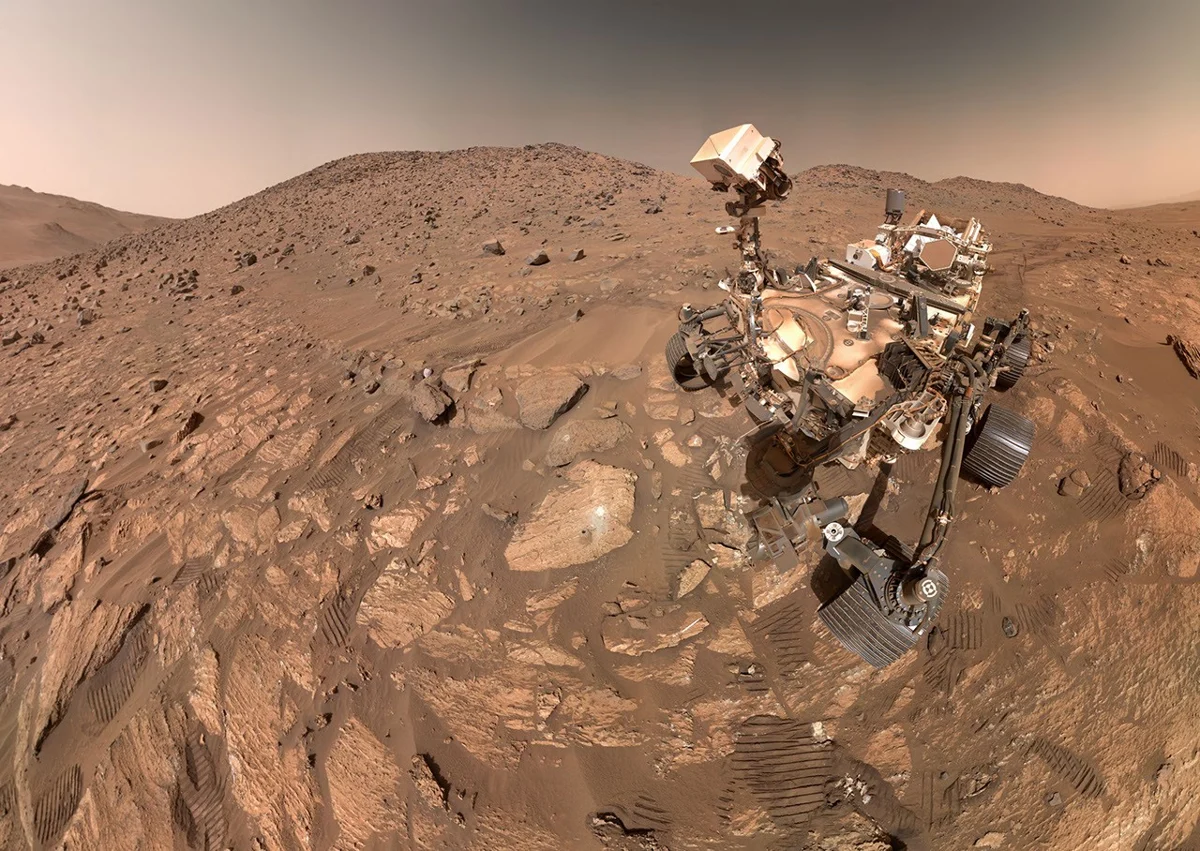
Perseverance landed in Jezero Crater on Mars on 18 February 2021. The site was selected for investigating ancient lake and delta environments. The mission extends beyond photographing rocks: establishing geological context, comparing chemical properties and recording selected samples are complementary research stages.
- Landing
- 18 February 2021
- Site
- Jezero Crater
- Field
- Geology and astrobiology
01 / RESEARCH LAYER
Reading a delta
On Earth, deltas are environments where river-transported material accumulates. Similar Martian forms provide a strong starting point, but topography alone does not determine every detail of past conditions. Rock layers, grain properties and mineral composition are assessed together.
02 / RESEARCH LAYER
The same rock, different instruments
Cameras provide context and texture; spectroscopic instruments investigate chemical and mineralogical properties. A measurement may represent only a tiny surface area. Combining nearby rover measurements with orbital maps helps place a local finding within the surrounding terrain.
03 / RESEARCH LAYER
Sample collection is a separate scientific step
Sample selection, clean collection, placement in tubes and recording the location are successive steps. Collection on Mars does not mean delivery to Earth. Later mission plans and schedules may change, so consult official programme sources for current status.
04 / RESEARCH LAYER
The evidence threshold in a search for life
Organic materials can form without biology. A possible indicator of ancient life must be tested against geological context and alternative explanations. Read the mission as measurements that increasingly constrain past Martian environments and habitability, rather than tying its value to a single claim.
05 / RESEARCH LAYER
Building an evidence chain for a rock
First locate the layer in a wide terrain image, then examine its texture up close. Ask whether a composition measurement belongs to that position or another nearby location. Do not assume every result about a rock measures the same volume. State which scientific question sample selection aims to answer. These steps do not prejudge a biological interpretation; they reveal the observation chain behind the claim. A result’s strength must be considered alongside how thoroughly alternatives have been tested.
CONNECTED INVESTIGATIONS
Where can you go from this dossier?
GO TO THE SOURCE
Turn reading into research.
Editorial review: . Mission status and catalogues can change; consult the official source for current information.
Image: NASA / JPL-Caltech / MSSS · Perseverance mission image.