
Cassini–Huygens
Years observing Saturn, with a probe that reached Titan’s surface.
Developed through cooperation between NASA, ESA and ASI, Cassini–Huygens demonstrates the scientific power of observing a planetary system over a long interval. The Cassini orbiter and Huygens probe that landed on Titan performed different roles. Studying rings, atmosphere and moons together revealed changes that a single flyby could not show.
- Launch
- 1997
- Saturn orbit
- 2004
- End of mission
- 2017
01 / RESEARCH LAYER
Orbital research and surface exploration
Cassini entered Saturn orbit in July 2004. Huygens descended through Titan’s atmosphere to the surface in January 2005. An orbiter’s broad map and a lander’s local measurements operate at different scales; they complement understanding of the same environment rather than replacing each other.
02 / RESEARCH LAYER
Multiple targets in one system
Ring structures opened particle motion to investigation, Titan’s atmosphere revealed chemical and meteorological processes, and Enceladus’s plumes provided access to its interior environment. Ocean-related findings strengthen habitability questions. They are not direct observations of life; chemical and geological explanations must be tested together.
03 / RESEARCH LAYER
Mission end is also part of design
Cassini ended its flight on 15 September 2017 with a controlled entry into Saturn’s atmosphere. End-of-mission planning included protecting scientifically interesting icy moons. Where a spacecraft is left at mission end matters alongside where it is sent during research.
04 / RESEARCH LAYER
Data outlive the mission
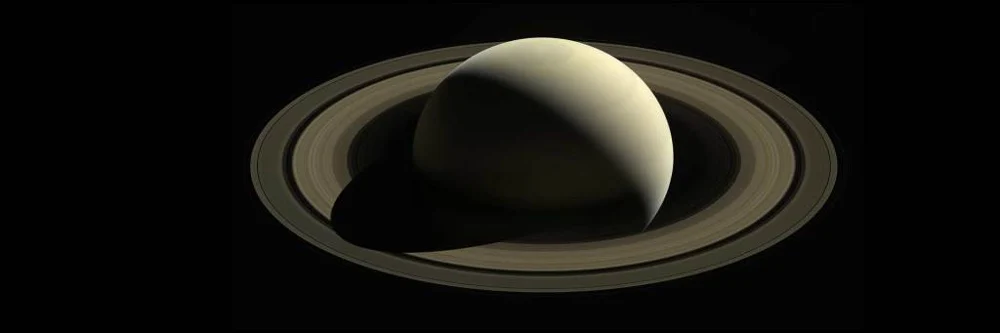
The archive’s scientific life does not end when flight operations finish. Images, particle measurements and spectra collected at different times can be studied with new methods. State observation date, measured quantity and model separately when evaluating a finding. The Saturn image here provides mission context, not a live camera feed.
05 / RESEARCH LAYER
An exercise in questioning a ring image
When comparing two Saturn photographs, record three questions first: were they taken at the same wavelength, was the Sun on the same side, and were viewing angles similar? Particle scattering and ring-plane geometry can change appearance. Interpreting that change as actual loss of material requires additional measurements. Add the dates and distinguish possible temporal change from observing conditions. This comparison is a first step in turning a bright photograph into a measurement.
MISSION TIMELINE
Read the dates and the results together.
- 1997-10-15 — Launched on a Titan IVB; gravity assists at Venus, Earth and Jupiter.
- 2004-07-01 — Saturn orbit insertion.
- 2005-01-14 — The Huygens probe landed on Titan: the first landing in the outer Solar System.
- 2005-11 — Water plumes imaged over Enceladus’s south pole.
- 2010-02 — Solstice mission extension: seasonal change on Saturn was followed.
- 2017-04-26 — Grand Finale: the first dive between the rings and the planet.
- 2017-09-15 — Controlled entry into Saturn’s atmosphere; the 13-year orbital mission ended.
Key results
- A global ocean beneath Enceladus’s ice shell and organic molecules in its plumes.
- Methane–ethane lakes and seas on Titan; a rain and season cycle.
- The detailed structure of the rings and the hexagonal jet stream at the north pole.
Dates from agency mission pages; planned steps are marked “planned”. Editorial compilation: 28 October 2026. NASA · Cassini
IN DEPTH
Cassini–Huygens in depth: 294 orbits, one landing and a data set still producing results
Cassini–Huygens ended in 2017, but much of its science is still being published. This section puts numbers on the spacecraft and its tour, describes what the Huygens descent and the Grand Finale orbits actually measured, and follows three results that have changed since the mission ended: the age of the rings, phosphorus in Enceladus’s ocean and organic molecules in fresh plume grains.
The spacecraft and the tour in numbers
At launch, Cassini with the Huygens probe and propellant weighed 5,712 kg; by the end of the mission it was down to 2,125 kg, having used 2,950 kg of its 2,978 kg of propellant. It was 6.7 m tall and 4 m wide and carried 12 science instruments on the orbiter. Its radioisotope generators supplied 885 W at launch and 633 W at the end.[1] To reach Saturn it flew past Venus twice (April 1998 and June 1999), Earth once (August 1999) and Jupiter once (December 2000).[1]
| Measure | Total |
|---|---|
| Saturn orbits | 294 |
| Targeted moon flybys (Titan / Enceladus) | 162 (127 / 23) |
| Images | 453,048 |
| Science data | 635 GB |
| Science papers (to 2017) | 3,948 |
| Named moons discovered | 6 |
| Total cost | $3.9 billion |
Those totals come from NASA’s mission summary.[1] More than 5,000 people and 27 nations took part.[1][2] After the four-year prime mission came the Equinox extension (2008–2010) and the Solstice extension (2010–2017).[1]
Huygens on Titan
ESA’s Huygens probe separated from Cassini on 24 December 2004 and coasted for 21 days to Titan. On 14 January 2005 its descent through the atmosphere took 2 hours 27 minutes, and it kept transmitting from the surface for about 72 minutes until Cassini dropped below the horizon.[4][1] ESA’s list of its main results covers a full atmospheric profile, superrotating winds, dry river channels and lakebeds near the landing site, and low-frequency radio resonances that hint at a subsurface ocean.[4] It remains the only landing in the outer Solar System.
The Grand Finale as a gravity experiment
Between April and September 2017 Cassini made 22 weekly dives through the gap between Saturn and its innermost rings. The main goals were detailed maps of Saturn’s gravity and magnetic fields and a better estimate of how much material the rings contain.[3] Tracking how the rings’ gravity tugged on the spacecraft gave a ring mass of about 40% of the moon Mimas. Combined with how clean the ring ice is, that pointed to an age of 10–100 million years (Iess et al., Science, January 2019). The same analysis found that layers about 9,000 km below the cloud tops, which rotate once every 10 hours 33 minutes, take about 9 minutes longer to turn.[5]
The age question is still open. Simulations published in Nature Geoscience in December 2024 suggest that high-speed micrometeoroids vaporise on impact and their debris rarely settles on the rings. If so, clean rings could still be billions of years old. The authors say further work is needed.[6]
Enceladus: results that came after the mission
Analysis of ice grains from the plume, measured by Cassini’s Cosmic Dust Analyzer, found phosphates at concentrations at least 100 to 1,000 times higher than in Earth’s oceans (Postberg et al., Nature, June 2023). Phosphorus is one of the elements life on Earth needs.[7] A 2025 study in Nature Astronomy re-examined grains Cassini collected in 2008 about 21 km above the surface at roughly 18 km/s. Those grains were only minutes old, which reduces the chance that radiation in space altered them. The study identified new aliphatic and cyclic esters and ethers alongside previously known aromatic and nitrogen- and oxygen-bearing organics.[8] These are signs of a habitable environment, not of life.
Why the mission ended in Saturn
When Cassini entered Saturn’s atmosphere on 15 September 2017, it was travelling at 111,637 km/h relative to the planet. The one-way light time to Earth was then 83 minutes.[1] It was running low on the fuel used to adjust its course, and NASA chose to dispose of it in Saturn’s atmosphere so that it could never collide with Enceladus or Titan and contaminate future studies of their habitability.[3]
Data for researchers
Cassini imaging and ring data can be found through the PDS Ring-Moon Systems Node Cassini pages, which also link to the other NASA Planetary Data System nodes. Huygens descent and landing data have been in ESA’s Planetary Science Archive since 2006.
Sources for this section
- NASA — Cassini quick facts
- NASA — Cassini-Huygens by the numbers
- NASA — Fact sheet: Cassini’s Grand Finale
- ESA — Huygens: the top 10 discoveries at Titan
- UC Berkeley — Saturn hasn’t always had rings (17 January 2019)
- Sci.News — Saturn’s rings may be as old as the gas giant itself (17 December 2024)
- Freie Universität Berlin — New study proves existence of key element for life in the outer Solar System (14 June 2023)
- NASA JPL — NASA Cassini study finds organics “fresh” from ocean of Enceladus
In-depth section: 29 October 2026. Mission totals from NASA’s quick-facts page; the paper count reflects the end of the mission in 2017. Ring age remains debated.
INTERACTIVE LAB
How hard Saturn stretches Enceladus: tidal force
The lab opens on the Saturn → Enceladus preset: from 238,000 km away, Saturn stretches Enceladus, a moon only 252 km in radius, with a tidal acceleration of about 0.00142 m/s². That is about 1,290 times the Moon’s tide on Earth and about 1.25% of Enceladus’s own surface gravity. Then select Jupiter → Europa: the acceleration is similar (about 1,190 times the lunar tide), but on the much larger Europa it is only about a thousandth of the surface gravity.
CONNECTED INVESTIGATIONS
Where can you go from this dossier?
GO TO THE SOURCE
Turn reading into research.
Editorial review: . Mission status and catalogues can change; consult the official source for current information.
Image: NASA / JPL-Caltech / Space Science Institute · View of Saturn.