
Uranus
A tilted axis, extreme seasons and a world still sparsely explored.
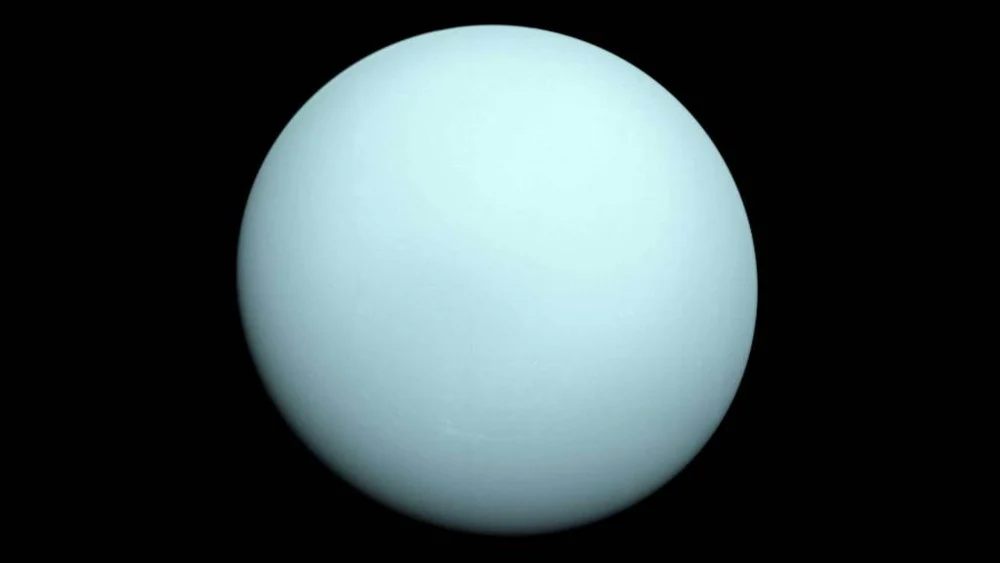
Uranus’s rotation axis is almost on its side relative to its orbital plane. This geometry makes it an unusual example for considering seasons. Its pale-blue appearance may suggest a quiet, simple world, yet its atmosphere, magnetic environment and internal heat budget still raise fundamental research questions.
- Class
- Ice giant
- Mean radius
- 25.362 km
- Mean distance from the Sun
- 19,191 AU
- Orbital period
- 30,688.5 Earth days
01 / RESEARCH LAYER
What does ice giant mean?
Calling Uranus an ice giant does not mean it is a cold, solid ball of ice. Materials associated with water, ammonia and methane are important inside at high pressures and temperatures. Hydrogen and helium occur in the outer layers. Interior inferences depend on models constrained by available measurements.
02 / RESEARCH LAYER
Layers beyond the blue colour
Atmospheric methane absorbs some red light, contributing to visible colour. Clouds and haze also affect appearance. Images taken at different times or through different filters do not have identical colours. Scientific images should not automatically be assumed to reproduce precisely what a human eye would see.
03 / RESEARCH LAYER
An eighty-four-year seasonal cycle
One Uranian year lasts approximately 84 Earth years. Its extreme axial tilt can give the poles long periods of light and darkness. Rotation takes about 17 hours. A brief mission flyby samples only a very small part of this long seasonal cycle.
04 / RESEARCH LAYER
Rings and diverse surfaces
Uranus has dark rings and many natural satellites. Miranda’s rugged terrain and geological traces on Ariel and other large moons show a varied system. Check catalogue dates rather than assuming a permanently fixed moon count; discoveries and names of small bodies change over time.
05 / RESEARCH LAYER
From Voyager 2 to long-term observation
Voyager 2’s 1986 flyby was a fundamental milestone in close investigation. Ground- and space-based telescopes later studied changing clouds and rings through different methods. Flyby data and years of remote observation have different strengths; combining them provides a fuller picture.
06 / RESEARCH LAYER
The depths of an ice giant
How is matter layered inside Uranus? What produced its extreme axial tilt? Why is its magnetic field not a simple centred dipole? How can its internal energy budget be explained? These questions make Uranus not just a distant destination but also a valuable comparison for understanding common exoplanet sizes.
READ THE NUMBERS TOGETHER
One world beside another.
Uranus’s mean radius is approximately 3.98 times Earth’s; its orbital period is approximately 84.02 Earth years.
| Planet | Radius / Earth | Distance / AU | Year / Earth year |
|---|---|---|---|
| Mercury | 0,38 | 0,387 | 0,24 |
| Venus | 0,95 | 0,723 | 0,62 |
| Earth | 1,00 | 1,000 | 1,00 |
| Mars | 0,53 | 1,524 | 1,88 |
| Jupiter | 10,97 | 5,203 | 11,86 |
| Saturn | 9,14 | 9,537 | 29,46 |
| Uranus | 3,98 | 19,191 | 84,02 |
| Neptune | 3,86 | 30,069 | 164,77 |
These are rounded mean values. The AU is based on the mean Earth–Sun distance; actual distance changes along an orbit. One Earth year is taken as 365.25 days. The size ratio is not a mass or surface-gravity ratio.
NEXT DISCOVERY
Change the scale. Deepen the question.
GO TO THE SOURCE
Turn reading into research.
Editorial review: . Mission status and catalogues can change; consult the official source for current information.
Image: NASA / JPL-Caltech · View of Uranus.