
Mars
From traces of ancient water to the changing conditions of planets.
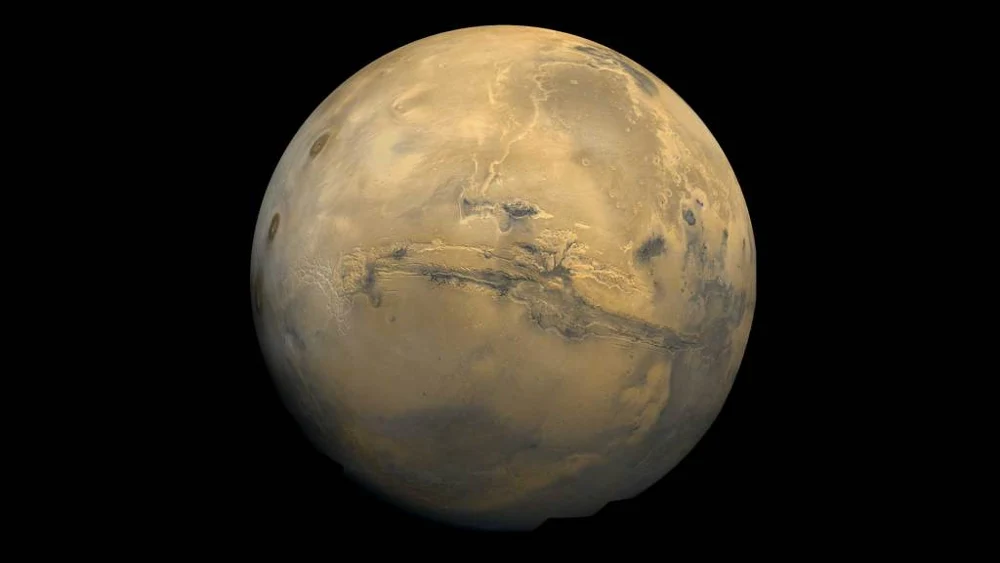
Mars’s red surface is a field archive of planetary history. Valleys, lake sediments and altered minerals allow investigation of ancient environments different from today’s cold, dry conditions. Past water and past life are separate conclusions; Mars research preserves this distinction while considering geology, chemistry and habitability together.
- Class
- Rocky planet
- Mean radius
- 3.390 km
- Mean distance from the Sun
- 1,524 AU
- Orbital period
- 687.0 Earth days
01 / RESEARCH LAYER
Reading the past in rocks
Mars has large volcanoes, deep canyons, impact basins and sedimentary layers. Iron-bearing minerals contribute to its characteristic colour. InSight’s seismic measurements opened a window onto the interior different from surface imagery. A rock’s age need not be the same as the time when sediment accumulated at its present location.
02 / RESEARCH LAYER
Thin atmosphere, changing dust
Its atmosphere, mainly carbon dioxide, is much thinner than Earth’s. Low pressure, cold conditions and solar radiation constrain the surface environment. Dust matters at scales from local movement to large storms. Water ice and evidence of ancient flows require separate assessments of where water occurred and in what form during different periods.
03 / RESEARCH LAYER
A sol and long seasons
A Martian solar day, or sol, is approximately 24 hours 39 minutes. A Martian year lasts about 687 Earth days. Axial tilt produces seasons; orbital eccentricity also affects their lengths and conditions. Daily robot plans consider solar power, temperature and communication windows together.
04 / RESEARCH LAYER
Phobos and Deimos
Mars has two small, irregular natural satellites. Their origins and evolution remain under investigation. Surface shape alone does not prove an origin scenario; composition, orbit and interior information matter. Studying these moons also contributes to understanding the history of the wider Martian system.
05 / RESEARCH LAYER
From orbit to terrain
Viking provided early examples of extended surface investigations. Curiosity studies Gale Crater, while Perseverance investigates Jezero’s ancient environments. Broad orbital maps provide context for detailed rover measurements. Sample selection, preservation and possible later analysis are separate mission phases.
06 / RESEARCH LAYER
How is habitability tested?
During which periods was liquid water persistent, and for how long? How did atmospheric loss and internal activity change the surface? How can possible ancient biological traces be distinguished from non-biological processes? An interesting rock or organic molecule is not, by itself, evidence of life; geological context and independent measurements are required.
READ THE NUMBERS TOGETHER
One world beside another.
Mars’s mean radius is approximately 0.53 times Earth’s; its orbital period is approximately 1.88 Earth years.
| Planet | Radius / Earth | Distance / AU | Year / Earth year |
|---|---|---|---|
| Mercury | 0,38 | 0,387 | 0,24 |
| Venus | 0,95 | 0,723 | 0,62 |
| Earth | 1,00 | 1,000 | 1,00 |
| Mars | 0,53 | 1,524 | 1,88 |
| Jupiter | 10,97 | 5,203 | 11,86 |
| Saturn | 9,14 | 9,537 | 29,46 |
| Uranus | 3,98 | 19,191 | 84,02 |
| Neptune | 3,86 | 30,069 | 164,77 |
These are rounded mean values. The AU is based on the mean Earth–Sun distance; actual distance changes along an orbit. One Earth year is taken as 365.25 days. The size ratio is not a mass or surface-gravity ratio.
NEXT DISCOVERY
Change the scale. Deepen the question.
GO TO THE SOURCE
Turn reading into research.
Editorial review: . Mission status and catalogues can change; consult the official source for current information.
Image: NASA / JPL-Caltech · Global view of Mars.