
Türkiye’s Space and Satellite History
From BİLSAT to İMECE, and from university CubeSats to future constellations: read the dates and missions separately.
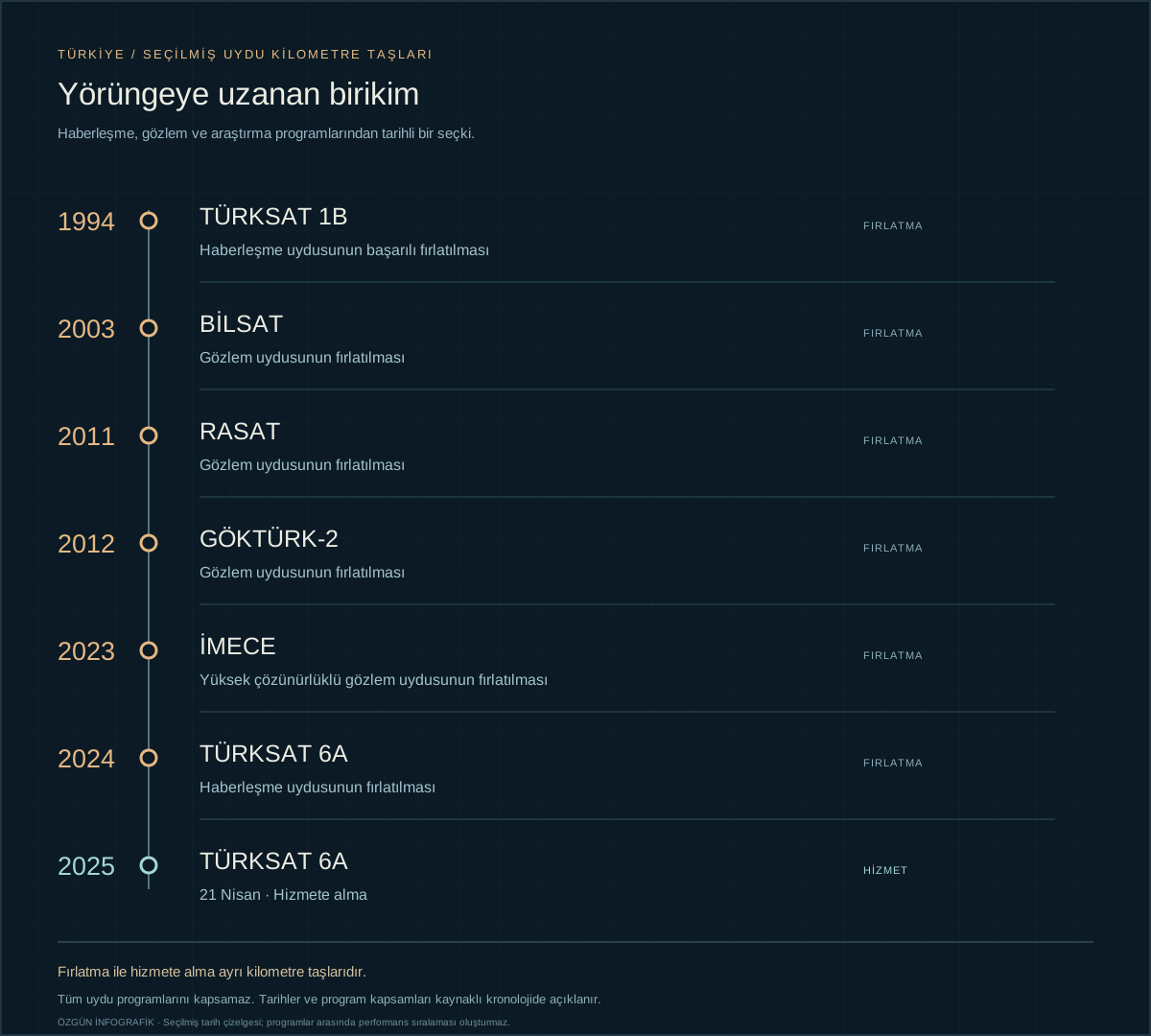
Reading space history through more than launch counts
Türkiye’s satellite expertise developed through communications, Earth observation and experimental missions together. This dossier follows observation and small satellites; the commercial Türksat family is covered separately. Design, manufacture, launch and operations are different capabilities. Rocket lift-off, deployment from a station and commissioning may also have different dates.
2003: BİLSAT builds technology and expertise
Launched on 27 September 2003, BİLSAT was an Earth-observation project carried out by TÜBİTAK UZAY with the objective of technology transfer. Its gains extended beyond imagery: it also established infrastructure including a ground station, clean room and design and operations training. The ÇOBAN camera and GEZGİN image-processing board contributed spaceflight experience for domestic equipment. BİLSAT retired in August 2006. Although its pioneering historical role endures, it should not be added to today’s operational satellite list.
2011: RASAT and the image archive
Designed and manufactured in Türkiye, RASAT launched on 17 August 2011. It operated for approximately eleven years against a three-year design life, providing experience in long-term observation-technology operations. Camera data supported areas including mapping, agriculture, disaster monitoring and urban planning. The mission’s end does not remove the value of its image archive or the people it trained. TÜBİTAK UZAY gives the retirement date as 23 August 2022; the news item dated 28 August announced mission completion to the public.
GÖKTÜRK-2 and GÖKTÜRK-1: Different paths within the same family
Launched on 18 December 2012, GÖKTÜRK-2 brought TÜBİTAK UZAY and TUSAŞ’s development expertise into high-resolution observation. National design, production and testing strengthened personnel and systems-development infrastructure. GÖKTÜRK-1, launched on 5 December 2016, was a separate project involving an international division of work. Alongside TUSAŞ’s engineering and production contributions, acquiring the Satellite Assembly, Integration and Test Centre was important. Presenting GÖKTÜRK-1 as an entirely domestic design, or GÖKTÜRK-2 as the second satellite under the same contract, erases these differences.
2023: İMECE and sub-metre observation
İMECE was sent into space on 15 April 2023. Through sub-metre-resolution electro-optical observation capability developed in Türkiye, it built expertise in cameras and other subsystems as well as the satellite platform. TÜBİTAK’s statements from 2025 document operation in orbit and entry into the Air Force inventory. İMECE-2 and İMECE-3, by contrast, are new constellation projects under development. The announced years 2027 and 2028 should be read as the target schedule in that statement, not as completed flights.
CubeSats: Students encounter a real space system
ITUpSAT1, developed at ITU, launched on 23 September 2009; TURKSAT-3USAT, intended for amateur communications, launched on 26 April 2013. Students participated in design, testing and ground-station operations. USTTL’s environmental testing and integration infrastructure allowed systems engineering learned in class to become real mission responsibility. Small size does not mean an easy mission: power, communications, attitude and thermal balance must be solved within the same limited volume. The importance of university projects lies not only in satellite numbers but in the people who experience these processes.
[8] Istanbul Technical University · [9] Istanbul Technical University
Transport to a station and deployment into independent orbit
UBAKUSAT travelled to the International Space Station on a Dragon cargo flight on 2 April 2018. Deployment from the station into independent orbit took place on 11 May; ITU’s ground station confirmed communications and command exchange that day. Combining the initial rocket launch and the start of a satellite’s free flight into one date is misleading for such missions.
[10] ITU USTTL · [11] ITU USTTL · [12] TAMSAT – Project Partner
Grizu-263A: From Zonguldak to orbit
The pocket satellite of Zonguldak Bülent Ecevit University’s Grizu-263 team launched on Falcon 9 on 13 January 2022. The team reported separation and first signals approximately one hour later. The name Grizu-263 commemorates the 263 miners killed in the 1992 Kozlu mining disaster. This work turned the sustained efforts of a student community, advisers and supporters into a real orbital mission. A model-satellite competition and a pocket satellite in orbit are different achievements; each should be recognised within its own scope.
Not every mission remains operational
QB50’s HAVELSAT and BeEagleSat were small scientific satellite missions deployed from the station in 2017. ITU’s HAVELSAT summary dated 2026 records the mission period as 2017–2019. A launch announcement alone does not verify current functionality; the table distinguishes retired satellites and dated mission records.
[14] Istanbul Technical University · [15] ITU USTTL project lead / TUYAD workshop
TIMELINE / 29 MILESTONES
Every milestone tells part of an accumulated history.
Selected events; not an exhaustive inventory of all space history.
Showing 29 records.
Türksat 1A launch
Documented historical recordThe launch failed.
Türksat 1B launch
Documented historical recordSent into space; subsequent testing and service stages were tracked separately.
Türksat 1C launch
Documented historical recordSent into space; subsequent testing and service stages were tracked separately.
[18] Türksat · [19] Türksat · [20] Turkish Space Agency · [21] Türksat
Türksat 2A (Eurasiasat 1) launch
Documented historical recordSent into space; subsequent testing and service stages were tracked separately.
[18] Türksat · [16] Türksat · [19] Türksat · [20] Turkish Space Agency · [21] Türksat · [22] Türksat
BİLSAT in space
Documented historical recordThe technology-transfer project built Earth-observation and infrastructure expertise.
Türksat 3A launch
Documented historical recordSent into space; subsequent testing and service stages were tracked separately.
ITUpSAT1 launched
Documented historical recordITU’s experimental CubeSat was sent into orbit.
RASAT launched
Documented historical recordAn Earth-observation satellite designed and manufactured in Türkiye.
GÖKTÜRK-2 launched
Documented historical recordThe joint development expertise of TÜBİTAK UZAY and TUSAŞ reached orbit.
TURKSAT-3USAT launched
Documented historical recordA university CubeSat for amateur communications.
Türksat 4A launch
Documented historical recordSent into space; subsequent testing and service stages were tracked separately.
Türksat 4B launch
Documented historical recordSent into space; subsequent testing and service stages were tracked separately.
GÖKTÜRK-1 launched
Documented historical recordThe optical observation mission was accompanied by acquisition of USET infrastructure.
HAVELSAT deployed
Documented historical recordThe QB50 mission moved from the ISS into independent orbit.
BeEagleSat deployed
Documented historical recordThe small scientific satellite was deployed from the ISS.
UBAKUSAT transported to the ISS
Documented historical recordThe journey began aboard Dragon CRS14 cargo.
UBAKUSAT deployed and contacted
Documented historical recordGround-station contact followed deployment from the ISS.
Türksat 5A launch
Documented historical recordSent into space; subsequent testing and service stages were tracked separately.
5A entered service
Documented historical recordThe post-launch orbital transfer and testing stage was completed.
Türksat 5B launch
Documented historical recordSent into space; subsequent testing and service stages were tracked separately.
Grizu-263A launched
Documented historical recordThe first signals were received from Zonguldak’s pocket satellite.
5B entered service
Documented historical recordThe high-data-capacity satellite began operations.
RASAT completed its mission
Documented historical recordApproximately eleven years of observation came to an end.
İMECE launched
Documented historical recordDomestic sub-metre electro-optical observation capability reached space.
Türksat 6A launch
Documented historical recordSent into space; subsequent testing and service stages were tracked separately.
6A at its operational position
Documented historical recordIt reached its final operational position at 42° East.
6A’s first test broadcast
Documented historical recordBroadcasting capability was tested in orbit.
6A entered service
Documented historical recordThe official handover and commissioning ceremony took place.
No matches found. Shorten your search or clear the filters.
Continue your research.
The Turkish Space Industry
Türkiye’s satellite, ground segment, launch and research ecosystem; source-linked dossiers on public bodies, private companies and universities.
02 / RESEARCH DOSSIERTurkish Satellites
The missions, launches and documented status of the TÜRKSAT family, BİLSAT, RASAT, GÖKTÜRK, İMECE and small satellites.
03 / RESEARCH DOSSIERAviation and Space Research Library
Aviation and Turkish space industry publications, official handbooks, technical report archives and research questions, searchable by subject.
REFERENCES / OPEN RESEARCH
Follow the evidence.
- BİLSAT ↗
- RASAT ↗
- Our Domestic Observation Satellite RASAT Completes Its Mission! ↗
- GÖKTÜRK-2 ↗
- TUSAŞ at SATELLITE 2017 with Satellite Design, Manufacturing, Integration and Test Capabilities ↗
- İMECE ↗
- TÜBİTAK Celebrates World Space Week ↗
- The Second Satellite Built at ITU, TURKSAT-3USAT, Is in Space ↗
- Space Systems Design and Test Laboratory ↗
- UBAKUSAT, Our Country’s Satellite Sent into Space, Comes from ITU ↗
- UBAKUSAT Is in Orbit! ↗
- UBAKUSAT in Orbit ↗
- Grizu-263A Is in Space! ↗
- HAVELSAT: 2U CubeSat Developed with the Contribution of ITU-USTTL ↗
- CubeSats in Türkiye – Alim Rüstem Aslan ↗
- Satellite Communications 101 — Türksat Satellites, pp. 78–79 ↗
- A Century of Science in the Republic — Our First Satellite, TÜRKSAT ↗
- Satellite History ↗
- Satellite Catalogue — End-of-Life Satellites ↗
- Our Space History ↗
- Satellite Fleet — End-Of-Life Satellites (previous version) ↗
- Channel Transfers to Türksat 4A Completed ↗
- Satellite Fleet ↗
- Türksat 3A — Technical Specifications ↗
- Türksat 4A — Technical Specifications ↗
- Türksat 4B — Technical Specifications ↗
- Türksat 4B Successfully Launched ↗
- Türksat 5A Turns Three ↗
- Türksat 5A Commissioned by the President ↗
- TÜRKSAT 5A ↗
- TÜRKSAT 5B ↗
- Türksat Annual Report 2024 — Türksat 5B ↗
- Türksat 6A Launched into Space: First Signal Received ↗
- TÜRKSAT 6A Tests Completed and Trial Broadcasting Begins ↗
- Our First Domestic and National Communications Satellite, TÜRKSAT 6A, Officially Begins Its Mission ↗
- TÜRKSAT 6A Completes Its First Year in Space ↗