
TESS
Searching for other worlds through small dips in starlight.
TESS launched in 2018 and uses the transit method in exoplanet research. It measures stellar brightness over time to find candidate planets passing in front of their stars. Its wide sky survey supplies research targets for more detailed follow-up observations.
- Launch
- 2018
- Method
- Transit photometry
- Measurement
- Stellar brightness over time
01 / RESEARCH LAYER
Reading a light curve
Observed light can decrease slightly when a planet crosses its star. Dip depth relates to the planet-to-star size ratio. Using this effect requires knowledge of stellar properties and measurement errors. Not every system is aligned so a transit is visible from Earth.
02 / RESEARCH LAYER
Surveying and follow-up are different tasks
TESS monitors many stars simultaneously. Detected signals can be investigated with other telescopes and methods. Radial-velocity measurements add mass information in some systems. Combining radius and mass permits mean-density estimates, but an interior model is still required.
03 / RESEARCH LAYER
Distinguishing candidates from confirmed planets
Binary stars and systematic effects can also produce dips. Confirming a candidate as a planet requires assessing these alternatives. Keeping candidate, confirmed and disputed catalogue classes distinct matters for scientific accuracy.
04 / RESEARCH LAYER
A research target, not life
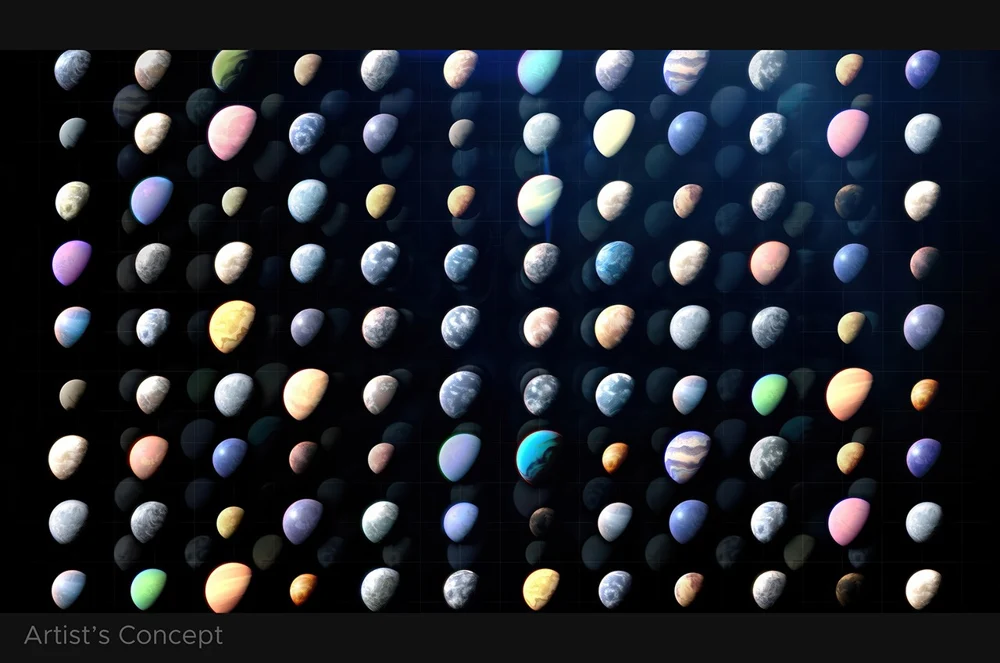
An object in the habitable zone does not necessarily have life on its surface. Atmosphere, stellar activity and energy balance require further investigation. The exoplanet visual here comprises artist’s impressions, not a suggestion that TESS photographs surfaces in detail.
05 / RESEARCH LAYER
Reading a transit model with its assumptions
In an elementary model with a uniformly bright stellar disc, transit depth relates to the square of the radius ratio. Limb darkening, additional light from another star and transit geometry can change the curve. Inferring planetary radius from a dip therefore requires stellar information and model choices. Even a regularly repeating signal does not exclude every alternative. Finding candidates and reliably determining their physical properties are successive research stages.
CONNECTED INVESTIGATIONS
Where can you go from this dossier?
GO TO THE SOURCE
Turn reading into research.
Editorial review: . Mission status and catalogues can change; consult the official source for current information.
Image: NASA / JPL-Caltech · Artist’s impressions of exoplanets.