
Neptune
Powerful atmospheric motion under weak sunlight.
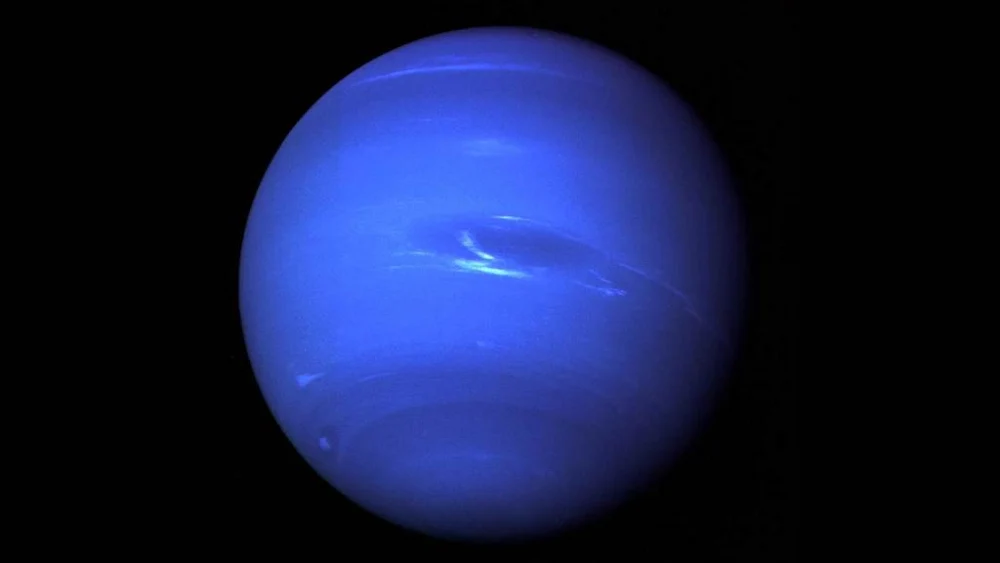
Neptune is the most distant of the eight planets from the Sun. Distance does not make it an inert ice sphere: clouds, storms and strong flows indicate an active atmosphere. Comparing it with Uranus is particularly valuable; despite similar sizes, their energy budgets and observed atmospheric behaviour differ.
- Class
- Ice giant
- Mean radius
- 24.622 km
- Mean distance from the Sun
- 30,069 AU
- Orbital period
- 60,182.0 Earth days
01 / RESEARCH LAYER
Depths hidden from view
Neptune is an ice giant, but this name does not describe a solid, cold surface to walk on. Pressure and temperature increase beneath the outer atmosphere. Heavy constituents associated with water, ammonia and methane are thought important internally. Details are investigated through gravity, thermal emission and physical models of matter.
02 / RESEARCH LAYER
Following storms over time
Methane and atmospheric hazes contribute to visible colour. Dark atmospheric structures should not be treated as one permanent surface marker; they can form and change. Filters, processing and observation dates matter when comparing images of a distant planet. An impressive blue image is not, by itself, a wind or temperature map.
03 / RESEARCH LAYER
A year longer than a human lifetime
Neptune orbits the Sun in approximately 165 Earth years and rotates in about 16 hours. Sunlight is much weaker there than at Earth, yet atmospheric activity continues. Accelerating the orbit in an educational model requires also making its long actual timescale explicit.
04 / RESEARCH LAYER
Triton’s unusual orbit
Triton is a large moon orbiting opposite Neptune’s rotation. This property is associated with the interpretation that it may have been captured. Voyager 2 revealed geological diversity and evidence of active surface processes. Neptune’s faint rings and other moons also contribute to the system; ring visibility depends on illumination geometry.
05 / RESEARCH LAYER
The long scientific life of one flyby
Voyager 2 flew past Neptune in 1989. Archive investigations and images from observatories such as Hubble and Webb allow comparisons across times and wavelengths. Having only a brief interval of close observation means uncertainties must remain visible when interpreting long-term changes.
06 / RESEARCH LAYER
The energy balance of distant worlds
How does energy emerging from Neptune’s interior drive atmospheric motion? What causes its differences from Uranus? How did Triton’s interior and history develop? Answers concern ice-giant formation and similarly sized extrasolar planets. A resemblance does not prove identical composition.
READ THE NUMBERS TOGETHER
One world beside another.
Neptune’s mean radius is approximately 3.86 times Earth’s; its orbital period is approximately 164.77 Earth years.
| Planet | Radius / Earth | Distance / AU | Year / Earth year |
|---|---|---|---|
| Mercury | 0,38 | 0,387 | 0,24 |
| Venus | 0,95 | 0,723 | 0,62 |
| Earth | 1,00 | 1,000 | 1,00 |
| Mars | 0,53 | 1,524 | 1,88 |
| Jupiter | 10,97 | 5,203 | 11,86 |
| Saturn | 9,14 | 9,537 | 29,46 |
| Uranus | 3,98 | 19,191 | 84,02 |
| Neptune | 3,86 | 30,069 | 164,77 |
These are rounded mean values. The AU is based on the mean Earth–Sun distance; actual distance changes along an orbit. One Earth year is taken as 365.25 days. The size ratio is not a mass or surface-gravity ratio.
NEXT DISCOVERY
Change the scale. Deepen the question.
GO TO THE SOURCE
Turn reading into research.
Editorial review: . Mission status and catalogues can change; consult the official source for current information.
Image: NASA / JPL-Caltech · Voyager 2.